Solid pack
Whole loin cylinder with a clean cut face. The premium retail style; the forming drum keeps the grain of the loin intact.
Loin in.
Sealed can out.
The Lion automatic tuna packing machine is the tuna canning machine at the heart of your line. It forms precooked loins into solid, chunk or flake portions, fills them by weight, doses oil or brine, and sends the can on to the seamer. One line, up to 240 or 480 cans a minute.
The machine
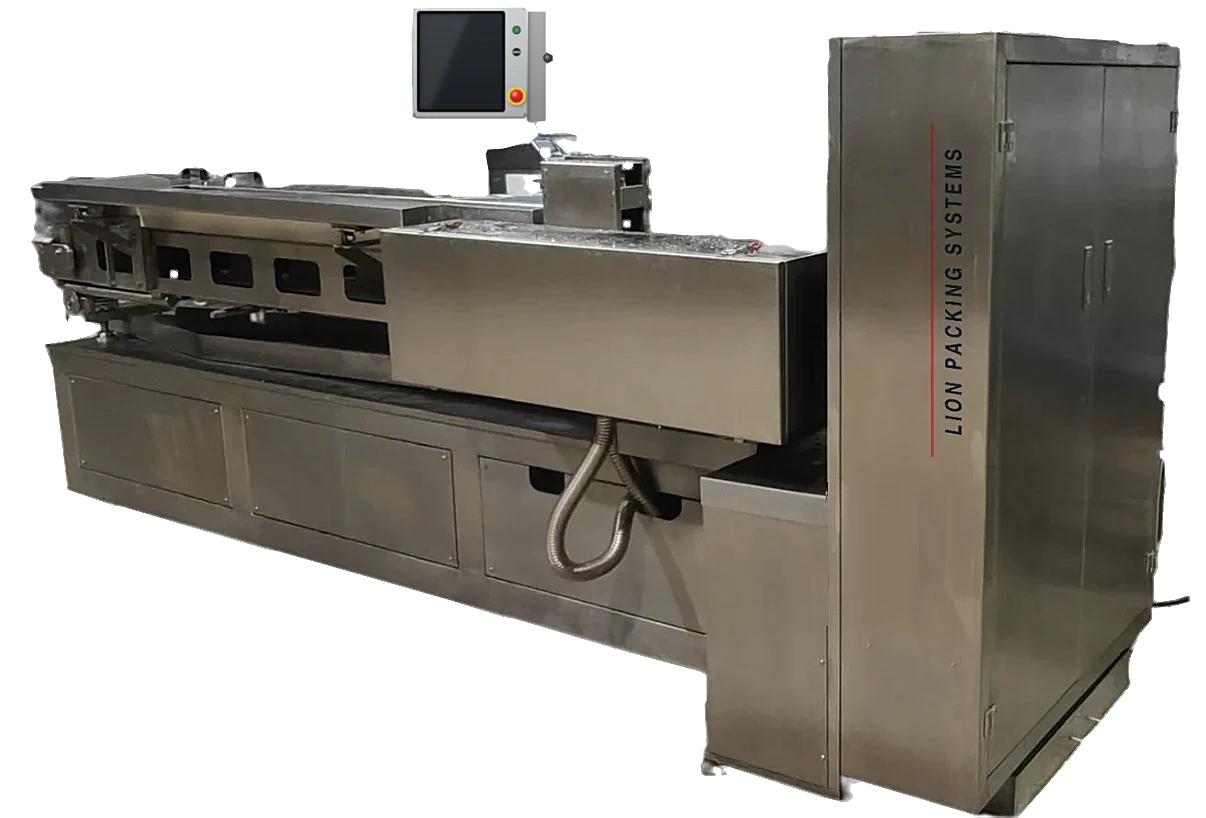
A fully stainless frame and covers, the operator panel on a swing arm, and a sealed control cabinet at the discharge end.
In production
Filmed on a working tuna plant floor: operators load precooked loins at the infeed, the forming and filling unit runs continuously, and filled product moves on to the next station.
Only from Lion
The Lion tuna packing machine is our own design, engineered in-house and factory-tested before shipment, and no other supplier offers this machine. It forms, cuts, fills, checkweighs and doses liquid in one stainless frame, so one supplier answers for the whole step from loin to seamer.
A pocket chain compresses the loins to the can diameter and cuts each portion, so solid, chunk and flake packs run on one machine.
An inline checkweigher reads every can and corrects the forming servo, holding solid pack to ±1.5 g.
The TP-480 puts two 240 cpm lanes in one machine for up to 480 cans a minute.
At Jinxing Seafoods a TP-240 runs at 120 cans a minute with one seamer today. A second seamer will take it to 240 without replacing the filler.
How the line runs
Cleaned loins arrive from the precooking and skinning room. From there the can never stops moving until it leaves the seamer.
Operators lay loins on a stainless infeed belt. A guide channel aligns them for the forming drum.
A pocket chain carries the loins through the forming tunnel, compresses them to the can diameter and cuts each portion. Solid, chunk and flake use interchangeable pockets.
In the discharge tower each portion is pushed into an empty can. Filled cans leave down a wire guide onto the outfeed conveyor.
An inline checkweigher reads every can and feeds the error back to the forming servo. Out-of-tolerance cans are rejected before liquid dosing.
Piston dosers or free flow add oil, brine or water. The seamer drops a lid on each can and double-seams it closed, ready for the retort.
Supported can sizes
Codes follow the US can-maker convention: diameter × height in inches and sixteenths. Change parts for each format ship with the machine you order.
Other diameters, including 603 food-service cans and aluminium easy-open formats, are available on request.
Pack styles
Swap the forming die and dosing recipe from the operator panel. Most plants run two styles on the same shift.
Whole loin cylinder with a clean cut face. The premium retail style; the forming drum keeps the grain of the loin intact.
Loins pre-cut into pieces and volumetrically filled. Suits skipjack and lower-grade loins while keeping visible texture.
Fine flake from trim and small loins, filled by auger or piston. Recovers yield from material that would otherwise go to meal.
Models
Both share the same forming principle and controls. They differ in the number of lanes, dosing heads and seamer pairing.
Single lane
cans per minute, rated
| Rated speed | up to 240 cpm |
|---|---|
| Lanes | 1 |
| Can diameters | 211 · 300 · 307 · 401 |
| Fill weight range | 60–400 g |
| Accuracy (solid) | ±1.5 g |
| Liquid dosers | 1–2 |
| Installed power | 11 kW · 380/440 V · 3 ph |
| Compressed air | 0.6 MPa · 250 NL/min |
| Footprint | 4.8 × 2.1 m |
| Operators | 4–6 on infeed |
Construction
Tuna plants wash down twice a shift with hot water and caustic. The machine is built for that from the frame up.
No horizontal ledges where water and fish oil can pool. Every product-contact part comes off without tools for cleaning.
Servo motors and the stainless control cabinet are rated for direct hose-down.
Store can size, pack style and target weight per SKU. Recall a recipe and the servos reposition themselves.
The panel logs average overfill per shift in grams and as a share of target, so plant managers can see what the line costs in fish.
Timed discharge to most vacuum seamers in the 60–300 cpm range. We supply the matching seamer if you need one.
Questions
It turns precooked tuna loins into filled, closed cans. The Lion machine forms the loins to the can diameter, cuts each portion, pushes it into the can, checks the weight, adds oil, brine or water, and hands the can to the seamer for double seaming. The sealed cans then go to your retort.
Lion designed and builds this machine itself, and no other supplier offers the same one. A single machine forms the loins to the can diameter, fills by weight with closed-loop checkweighing, and doses oil or brine, and the same line runs solid, chunk and flake packs.
The TP-240 fills up to 240 cans per minute on one lane. The TP-480 puts two 240 cpm lanes in one frame for up to 480 cans per minute. Both fill 60–400 g per can.
Can diameters 211, 300, 307 and 401, in solid, chunk and flake packs. Each SKU is saved as a recipe, so a format change takes under 15 minutes.
±1.5 g on solid pack. An inline checkweigher reads every can and corrects the forming servo, cans out of tolerance are rejected before liquid dosing, and the panel logs overfill per shift.
Yes. The discharge is timed to most vacuum seamers in the 60–300 cpm range, and we can supply a matching seamer if you need one.
Yes. Besides the packing machine we supply a matching can seamer, and labeling, case packing and palletizing machines for the end of the line.
Request a quotation
Leave your name, contact details, product and capacity. Your inquiry goes straight to our sales team, and we reply with a layout and price.